
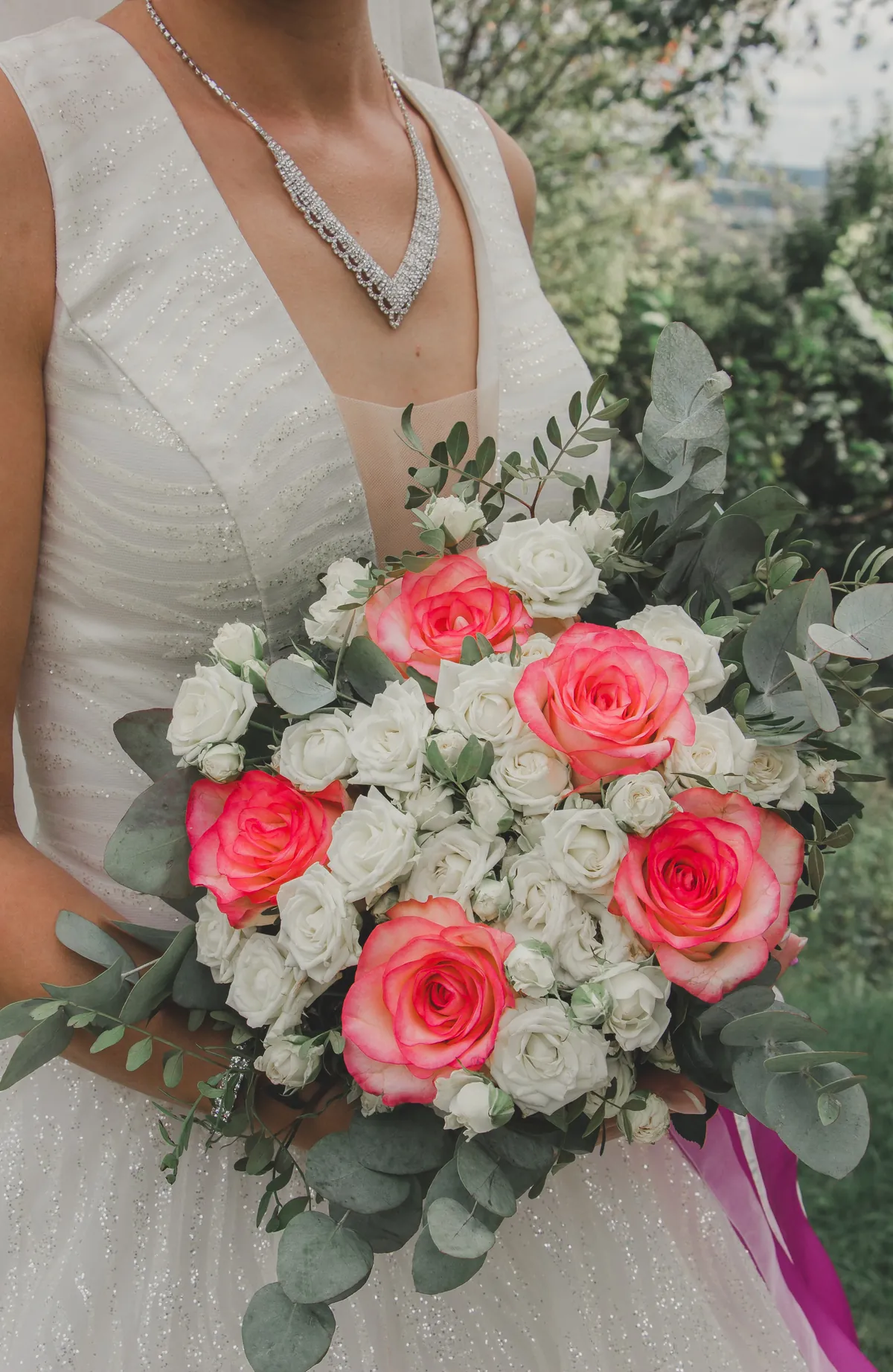
Real vs artificial wedding flowers: the honest comparison
Real vs artificial wedding flowers: honest 2026 Aussie pricing, what guests actually notice, the real sustainability picture, and why a mix usually works best.
Most articles about real versus artificial wedding flowers have already decided what they want you to do before they start writing. The florist tells you fresh is the only option that looks good. The artificial flower company tells you faux is smarter, cheaper, and nobody can tell the difference. Both of them are selling something.
This article isn’t. Nobody’s paying us to push one option over the other, and we don’t sell flowers. So here’s the version that doesn’t have a commission cheque attached to it.
What you’ll actually spend
The average Australian couple spends $2,639 on wedding flowers according to Easy Weddings’ 2025 Industry Report, which surveyed over 4,000 couples. Their 2026 report found floral spending rose another 8% year on year, reflecting what every florist I’ve spoken to has been saying about growing costs.
Here’s where it goes, based on what real Australian florists are charging in 2026:
Bridal bouquet: $200 to $450. The range covers everything from a simple tied bunch of seasonal natives to a cascading arrangement with imported blooms. Most couples land around $300 to $350.
Bridesmaid bouquets: $100 to $200 each. Smaller versions of yours, usually matching in style but simpler.
Buttonholes and corsages: $20 to $35 each. You’ll need these for the groom, groomsmen, fathers, and sometimes the celebrant and MC. Count your people before you budget; buttonholes multiply fast.
Centrepieces: $80 to $250 per table. Bud vases clustered together start around $25 per vase. Low lush arrangements for a bridal table can push past $300. For a wedding with 10 guest tables, centrepieces alone can run you $800 to $2,500.
Ceremony arrangements: $600 to $6,000+. An arbour or arch installation is usually the biggest single floral cost. Ground arrangements lining the aisle are cheaper, and a well-placed pair of statement arrangements at the altar can do the work of a full installation for half the price.
Delivery, setup, and breakdown: $150 to $400, often bundled into your quote. If your florist needs to stay through the ceremony to move arrangements from the chapel to the reception, that costs extra, and they should charge for it; it’s skilled work on a tight timeline.
Add it up for a wedding with a bridal party of four, eight guest tables, and a ceremony arch and you’re looking at $3,500 to $5,500. That’s the realistic range for a full fresh flower setup from a decent Australian florist.
What artificial costs
This is where most comparisons get lazy. They compare a $4,000 fresh flower quote with a $200 artificial bouquet from a craft store and declare artificial the winner on price. That’s like comparing a catered sit-down dinner to a servo pie.
Artificial wedding flowers exist on a massive quality spectrum.
At the bottom: the $30 bouquet from a discount homewares shop. Shiny plastic petals, obviously fake stems, colours that don’t exist in nature. Fine for a kitchen table. Not your wedding.
In the middle: basic silk flowers at $3 to $8 per stem. They photograph okay from a distance but feel wrong up close. Some couples use these for background decor where nobody gets near them.
At the top: premium real-touch or fresh-touch flowers at $10 to $25 per stem. These have a latex or polyurethane coating that mimics the weight, texture, and colour variation of real petals. Most guests can’t tell the difference, even holding them. Australian suppliers like Sonder + Stone report most couples spend around $2,000 for a complete premium artificial package: bridal bouquet, bridesmaid bouquets, buttonholes, and ceremony arrangements. Custom work with more stems and larger installations pushes toward $3,000 to $3,500.
If you’re DIY-ing, a premium real-touch bridal bouquet will run you about $150 to $300 in materials depending on how full you want it. Bridesmaid versions about $80 to $150 each.
So here’s the honest price comparison: at equivalent quality, fresh and premium artificial are in the same ballpark. Fresh might run $3,500 to $5,500 for a full setup. Premium artificial from a supplier runs $2,000 to $3,500. The gap is smaller than most people think, and it disappears entirely once you factor in what happens after the wedding.
More on that in a moment.
Can anyone actually tell the difference?
Short answer: it depends which artificial you bought.
Cheap artificial looks cheap. Everyone can tell.
Premium real-touch flowers are photographically convincing. In wedding photos, even close detail shots, you can’t see the difference on a screen. The texture and weight feel right in your hands. The colour variation in hand-painted petals reads as natural because it is natural; a human painted those colour shifts, one petal at a time.
What premium artificial doesn’t do is smell like flowers. There’s no fragrance. Some suppliers sell scent oils you can spritz on, but it’s not the same thing and anyone who tells you otherwise is selling something. If the smell of fresh flowers matters to you, artificial will disappoint you. That’s just the truth.
Fresh flowers have the advantage of being alive. The slight variation between stems, the way petals catch light differently at different angles, the softness you can’t fully replicate in synthetic materials. A good florist creates something that feels organic in a way artificial, even at its best, doesn’t quite match.
But fresh flowers have a window. By the evening reception, especially at a summer wedding, they’re not the flowers you walked down the aisle with. Bouquets have been handled, photographed, passed around, rested on tables. Centrepieces have been near candles and plates and elbows. They look softer by 8pm. Sometimes that’s romantic; sometimes they just look tired.
Artificial flowers look exactly the same at 11pm as they did at 2pm. For some couples that consistency matters. For others, the slow softening of fresh flowers is part of the experience.
What nobody tells you about fresh flower logistics
Here’s something most wedding articles gloss over because they don’t want to scare you: fresh flowers are a high-stakes logistics operation happening in the background of your wedding day, and when it goes wrong, it goes properly wrong.
Your florist is managing a perishable product with a 24-hour window of peak condition. They’re coordinating freight from growers, cold storage, conditioning, and assembly against a hard deadline. If a shipment of David Austin roses arrives bruised, there’s no backup; they work with what they’ve got or substitute. If the weather hits 38 degrees on your February wedding day in Adelaide, your arch flowers might be wilting before the ceremony starts. A florist I know once told me about a bride who walked down the aisle to a ceremony arch that had visibly wilted on one side because the venue’s air conditioning failed that morning. The florist did nothing wrong; physics doesn’t care about your wedding timeline.
Seasonality is the other thing. That peony-filled Pinterest board you’ve been collecting? Peonies have about a six-week window in Australia, roughly November to mid-December. If you’re getting married in March, you cannot get Australian-grown peonies. You can import them, but imported peonies arrive stressed from cold-chain freight, cost roughly triple the local price, and have an environmental footprint that would make you wince if you saw the numbers. Most florists will gently steer you toward something seasonal instead, and they’re right to.
Then there’s the morning-of pressure. Fresh flowers get delivered on the day. Your florist or their team arrives early, sometimes at 6am, to set up the ceremony space before guests arrive. If anything’s wrong, there’s no time to fix it properly. You’re getting married in three hours and the flowers are what they are.
Artificial flowers eliminate basically all of this. They arrive weeks or months before the wedding. You can check every arrangement, make changes, and pack them away until the day. No refrigeration. No wilting in heat. No panicked florist calls at 7am. For destination weddings, they travel without biosecurity restrictions or temperature anxiety. You can fly to Bali or Queenstown with your bouquet in your carry-on.
Whether that stress reduction is worth it depends on you. Some people genuinely enjoy the creative chaos of fresh flowers arriving on the day. For others, removing one variable from an already complicated morning is worth a lot.
The sustainability question (it’s messier than you think)
Both sides of the flower industry make environmental claims that don’t hold up to much scrutiny.
The fresh flower industry likes to position itself as natural and therefore sustainable. It’s not that simple. According to a May 2026 piece in Polka Dot Wedding quoting Victorian ethical florist Ali from Handpicked Ethical Floristry, imported flowers carry a massive carbon footprint from refrigerated freight, are heavily treated with chemicals at both the country of origin and Australian customs (where mandatory fumigation and inspection apply to all imported cut flower shipments), and arrive wrapped in what Ali describes as “heaps of plastic, paper and cardboard” that all gets disposed of here. There are also documented workers’ rights concerns in several major flower-growing regions.
Most flowers used in Australian weddings are imported. Local, seasonal, Australian-grown flowers are the genuinely sustainable option; they’ve travelled short distances, supported local farmers, and haven’t been fumigated at the border. But they’re only available for part of the year, and the selection is more limited. If you want a sustainable fresh flower wedding, you’re committing to working with what’s in season locally. That might mean natives in spring, dahlias in late summer, or paper daisies in autumn. It won’t mean roses in July or peonies in February.
Artificial flowers avoid the single-use problem. They don’t get thrown out 24 hours after the ceremony. A premium bouquet sits on display in your home, gets lent to a friend for her wedding, or gets sold on Facebook Marketplace to the next bride. There’s an active secondhand market for quality artificial wedding flowers; some couples recoup 30 to 50 percent of the cost.
But artificial flowers are made from polyester, silk, latex, and plastic. They’re petroleum-derived products with a manufacturing footprint. They’re not biodegradable; if they eventually end up in landfill, they stay there. The sustainability case for artificial rests entirely on reuse: the longer they’re kept and used, the more that initial manufacturing cost gets amortised across years instead of hours.
Neither option is clearly better for the planet. Local seasonal fresh flowers have the lowest impact if you’re willing to work within their constraints. Premium artificial flowers that get kept, displayed, and potentially resold avoid the waste of a single-use purchase. Imported fresh flowers are the worst environmental option, and most couples have no idea they’re choosing them.
Who should choose what
After talking to couples and vendors over the years, here’s what it comes down to.
Fresh flowers make more sense when: scent genuinely matters to you; you want that moment of walking into a room that smells like eucalyptus and garden roses; you’re getting married in a temperate season and can use local seasonal blooms; you’ve found a florist whose work you love and trust; the organic, slightly imperfect look of real flowers appeals to you more than perfect uniformity.
Artificial makes more sense when: your wedding is in peak Australian summer and you don’t want your flowers dying before the reception; you want specific blooms that are out of season (peonies in March, tulips in December, ranunculus in February); you or someone in your bridal party has bad hayfever; you’re planning a destination wedding; you want exact colour matching for a specific bridesmaid dress or decor palette; you want to keep your bouquet permanently.
The hybrid approach is underrated. This is what the smartest couples do. Real flowers for the bridal bouquet; the one you hold, the one in your detail shots, the one you smell. Artificial for the bridesmaids’ bouquets; they look identical in photos and nobody’s inspecting them up close. Artificial for the ceremony arch or arbour; it’s five metres away from every guest and nobody can tell. Real for the centrepieces if budget allows, artificial if it doesn’t. Real buttonholes for the groom and fathers if it matters to them; artificial for the groomsmen who’ll lose theirs by the third beer.
This isn’t a compromise. It’s allocating your money to where it actually makes a difference instead of spending evenly across everything and stretching your budget thin.
The thing you’ll actually remember
I’ve asked a lot of married couples this question: what do you remember about your wedding flowers? Nobody remembers the centrepieces. Nobody remembers whether the arch was fresh or artificial. Nobody remembers how many stems were in each bridesmaid bouquet. What they remember is whether the food was good and whether they had fun.
You’ll remember your bouquet because you held it. You’ll remember how it looked in your photos. That’s worth spending on. The rest is set dressing.
So pick the option that lets you stop thinking about flowers and start thinking about the actual wedding. If that means fresh from a florist you trust, do that. If it means premium artificial that arrives sorted a month early and removes the stress, do that. If it means a mix that puts your money where you care and skimps where you don’t, do that.
Then go book the band and sort the seating plan. Those are the things that actually go wrong.
If you’re still deciding on a florist, you can browse florists by location and style on Wedding Savvy. And once you’re planning, Wedding Savvy’s built-in budget tracker helps you keep tabs on exactly where your flower spend lands against the rest of the wedding.